
Our Joy is Not in the Trials, but in Him

MARYBETH MCGEE | GUEST Recently, my own words echoed in my head: “Our joy is not found in the trials, but in Him.” Those words—from an article I wrote here last Advent—were suddenly tested in a trial unlike any we weathered before. On May 22, 2025, our home erupted in chaos on the first morning of summer break. My middle son and I discovered that my oldest son had passed away—unexpectedly, quietly, without any warning. At just fourteen, he was gone, and there was nothing we could do. Years of waiting and praying for this child—and his brothers—felt ripped away in an instant. Powerless. Crushed. Broken. Even as I spoke with emergency services, I felt the battle for my soul begin. Shock, fear, anger, and a grief beyond words swirled inside me as I heard the familiar whisper echo from Genesis 3: “Did God really say?” Peter’s words became more real than ever—there truly is an enemy who prowls like a lion, seeking to devour (1 Peter 5:8). I knew this would be a test of my faith. Our family was being called to the front lines of spiritual warfare, and we needed reinforcements. My second call, just minutes later, was to my pastor. Like any good shepherd, he rushed to our home and stepped straight into the chaos. My husband was an hour away at work; our house filled with firefighters, paramedics, and sheriffs—faces my children had rarely seen outside of children’s shows, let alone in our front yard. Over the next several days and weeks, our home was a constant flow of people, tears, laughter, joy, and deep mourning. The circumstances were devastating, but something different was happening. Trials, both great and small, tend to stir up thoughts about gratitude—or the lack thereof. We can’t talk about gratitude without acknowledging the tension between our expectations and our circumstances. If anyone ever had an excuse to skip gratitude during a trial, the loss of a child would seem like a good one. But do we really get a pass because life feels unbearable? As you might guess, my answer is no...


Our Joy is Not in the Trials, but in Him2025-11-22T18:37:42+00:00

Happy Thanksgiving

CHRISTINA FOX | EDITOR Happy Thanksgiving to you and yours from all of us at enCourage! "...give thanks in all circumstances; for this is the will of God in Christ Jesus for you" (1 Thess. 5:18).

Happy Thanksgiving2025-11-16T16:30:24+00:00

It’s the Little Things

SHARON ROCKWELL | CONTRIBUTOR When I had emergency shoulder surgery from an accident while in Yellowstone, I was transported in a two-hour ambulance ride to a small hospital in Jackson. I was blessed with a fine orthopedic team there, very experienced from treating broken bones from all sorts of extreme sports accidents. When it came time to leave the hospital, the man who brought my meals each day presented me with a loaf of homemade pumpkin bread wrapped in cellophane with a note attached that said he hoped this would make my trip home a little sweeter. It was a little thing, but his kindness really lifted my spirits! Opportunities to Bless Others In the Thanksgiving season, we are provided with so many opportunities to practice being thankful by helping others. We give prayers of thanks for God’s grand plan for our redemption, but we also give thanks for His simple daily provisions. As the hands and feet of Jesus, we must be on the lookout for those opportunities where we can make life a little sweeter for someone else. It is the appropriate response for all our blessings. It is easy to overlook these possibilities. A neighbor you know is alone for the holiday. She might be included in yours. Those who must work at the grocery store on the holiday may appreciate a kind word of thanks. Not a day goes by that the mail does not contain a heart-warming request for donations. There are requests for holiday gifts for veterans and their families, meals for the homeless, and shoes for needy children. We might like to help them all, but it is easy to just pass. Paul gave practical advice to believers about living in grateful response to God’s blessings. “And whatever you do, in word or deed, do everything in the name of the Lord Jesus, giving thanks to God the Father through him” (Col. 3:17). We are called to resemble God the Father and His Son, Jesus, in compassion for others, in humble service, in kindness to all, and with gratitude in our hearts. This includes all our daily actions, great and small. Fruits of our Faith...

It’s the Little Things2025-11-05T20:12:23+00:00

The Art of Thankfulness

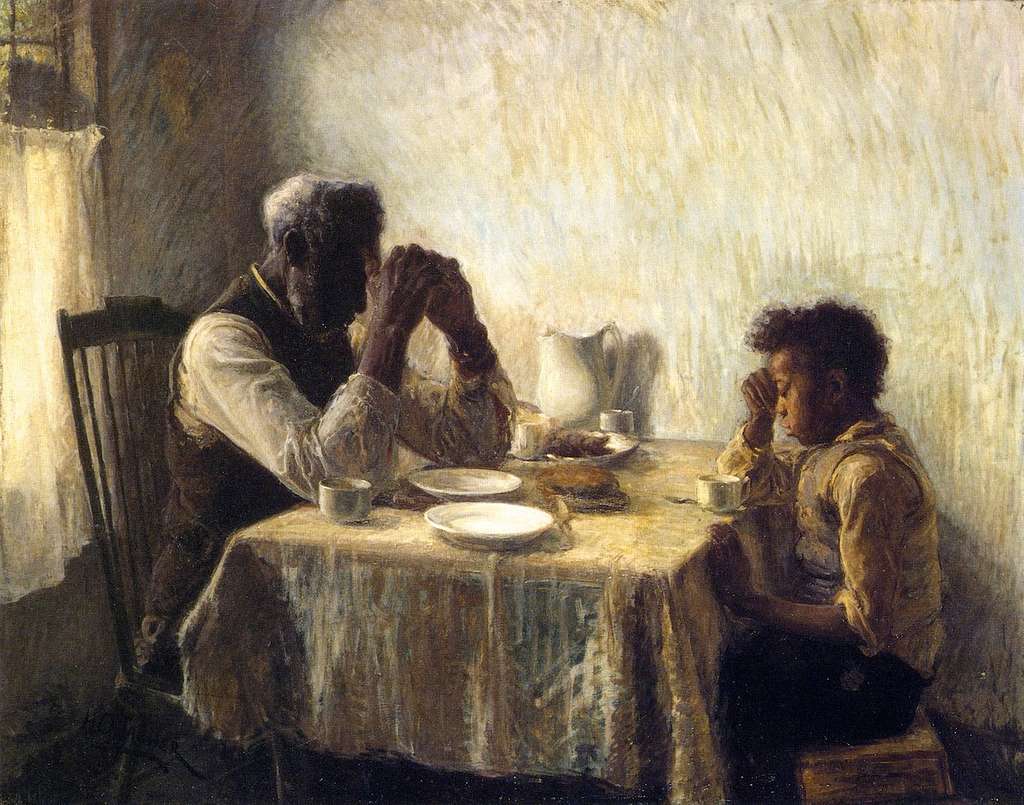
REBEKAH COCHELL | GUEST Henry Ossawa Tanner, The Thankful Poor,1894, Art Bridges Foundation currently exhibited at the Memphis Brooks Museum of Art. “Do not be anxious about anything, but in everything by prayer and supplication with thanksgiving let your requests be made known to God.  And the peace of God, which surpasses all understanding, will guard your hearts and your minds in Christ Jesus.” Philippians 4:6-7 Art can reveal truth, beauty, and goodness by depicting the spiritual transcendence of everyday life. “The Thankful Poor” by Henry Ossawa Tanner reveals a humbling lesson in thankfulness instead of merely offering us a depiction of the harsh realities of the late 1800s. Thanksgiving Reflected in Art Henry Ossawa Tanner was an artist born in Philadelphia in 1859. His experiences as a Black artist, during the Reconstruction and the Industrial Revolution in America, and in France shaped him as a Christian and an artist. He was a follower of Christ and painted many biblical narratives. He didn’t limit his Christian lens to just biblical paintings. His everyday “genre” scenes were imbued with deep emotional and spiritual depth, as well. As we look at this painting, we see an elderly man with graying hair and a young boy sitting at a table. The table is set simply, white dishes, cups, and pitcher with a modest meal, on top of a creamy yellow cloth tablecloth. The walls are bare and plain white. But the light from the window filtered through white curtains fills the room and all in it with an ethereal glow. The elderly man’s hands are clasped, eyes closed, and head bowed in a posture of reverent prayer. The young boy’s eyes are closed and head bowed, resting on one hand. His posture is a little less formal, as his left hand rests on the edge of the table. Their clothing, simple yet sophisticated, depicting care. The scene is reminiscent of a Vermeer; quiet, still, a moment in time that is transcendent. The window light illuminates the interior space. The simple white jug, an essential everyday item, represents life giving properties.  Like Vermeer, Tanner depicts those who labor, rather than those in positions of power. He is telling a story. But the story is not defined; we don’t know who the man and boy are other than what we can observe in the image and know from history. The title of the painting lets us know they are poor. The room, the table, and the meal confirm this. We know from history that the Reconstruction and the following Gilded Age, when this was painted, did not result in wealth for the Black community. It did not end racial discrimination. Tanner himself, though extremely talented, faced discrimination. His paintings would be shown in “separate” exhibits since he was not White. He left America to pursue his art career in Paris, where he was recognized and his talent celebrated.   While we can and should lament the past, Tanner rose above it, and above those who mistreated him. He did not wallow in the injustice but used it to paint truth as in this painting where he depicts the dignity and worth of the old man and young boy, created in the Imago Dei...

The Art of Thankfulness2025-11-05T19:36:31+00:00

The Antidote to Unmet Expectations this Thanksgiving

KERRY ANDERSON | GUEST So, it seems once again, just like all previous years, November follows October, and the holiday season is upon us. Let the planning and preparations begin—even though it was 80 degrees the other day where I live. In my current season of life, this preparation looks like coordinating dates and schedules with my married children and the teen still at home to see when we can be together. It also looks like starting the digital gift wish lists, making sure we have enough guest towels, and even revisiting traditions, recipes, and events to make sure they still suit everyone. My excitement grows with the planning, but so do my Hallmark movie-like expectations for every moment from now until New Year’s Day. Can’t you just see us all snuggled up in our matching pajamas? (Unmet) Expectations Because the holiday season often revolves around traditions, it’s good and reasonable to have certain expectations for how the days will go. If we’ve always run a Turkey Trot and eaten at 3 p.m. with chocolate pie for dessert, it makes sense our minds and hearts go there. If it’s been 30 years of the same prayer around the same table with Grandma Jane’s famous yeast rolls, of course we crave the delight and comfort in that. The Bible is full of examples of celebrations and feasts and remembrances that look the same each year (Lev. 23:33ff; Neh. 8:13ff; Job 1:4-5) so God’s people are stirred to fellowship, remember, and give thanks. This is good. However, life and the scriptures have also taught us that though we chart a course, the Lord is the one who determines our steps...

The Antidote to Unmet Expectations this Thanksgiving2025-10-25T14:02:28+00:00

Wearing Our Gospel Clothes

MELANIE COGDILL | GUEST Because we are movie buffs, for more than a decade, some friends from church and I have an annual Oscar watch party. We also evaluate the gowns celebrities wear as they present the awards. Why did she pick that dress? Does it look flattering on her—if not, what was she thinking? Even though not all women are fashionistas, we care about what clothes we wear to worship on Sunday. We put some thought into what we will put on. We do not roll out of bed in our pajamas and head to church. The Seed of Gospel Clothing Throughout Scripture, we see that what we wear is significant. Not our outward clothing, but how we are clothed with gospel truth. In fact, it is God Himself who makes us a garment of gospel clothes and puts it on us. In Genesis 3:7 after Adam and Eve took and ate the forbidden fruit, “the eyes of both were opened, and they knew that they were naked. And they sewed fig leaves together and made themselves loincloths.” After they do that, God comes to them (v.9) and “the Lord God called to the man and said to him, 'Where are you?'" And because the coverings they made for themselves were not sufficient, God clothed them (v. 21), “And the Lord God made for Adam and for his wife garments of skins and clothed them.” God comes to them after their sin in the Garden, and He makes garments to clothe them. This is the gospel in a nutshell. Putting on Our Gospel Clothes Our gospel clothing is much more significant than our physical clothing. After telling the Colossians the worldly things they must put to death (Col. 3:5-10), the Apostle Paul reminds them of the gospel clothing they must wear instead. The context of the gospel clothes they are to put on as the people of God is compassion, humility, meekness, patience, forgiveness, and above all, love for one another in the body. Those verses seem straightforward; however, it’s not always easy to love difficult people in our church, forgive a friend or spouse when we think we have been wronged, or be patient with a child’s behavior that is trying our patience. However, Paul’s admonition is to always “put on” these gospel clothes because we are called as God’s beloved people to be holy....

Wearing Our Gospel Clothes2025-07-21T17:57:24+00:00

Happy Thanksgiving

CHRISTINA FOX | EDITOR Happy Thanksgiving to you and yours from all of us at enCourage! "...give thanks in all circumstances; for this is the will of God in Christ Jesus for you" (1 Thess. 5:18).

Happy Thanksgiving2024-11-11T20:28:44+00:00

Grief in this Holiday Season: Gospel Comfort for Every Loss

ELIZABETH TURNAGE | CONTRIBUTOR Grief is as old as the Fall. Ever since Adam and Eve chose to disobey God, eating of the one tree denied them, loss has plagued the cosmos. This loss leads to grief. As the holidays arrive this year, grief will be fresh for many, raw for some. In the Middle East, Ukraine, Turkey, the Southeastern United States, and many other places throughout the world, disaster has struck, and the holiday season threatens to swallow its victims in a sea of grief. This year, your neighbor or friend, your co-worker or cousin, or perhaps you yourself, weep deeply and often as you mourn the loss of a loved one, a job, a relationship, a home, or a pet. How can we help? How can we grieve with hope if we are the ones who have suffered loss? By understanding grief and by looking to Christ, our grief may lead to the hope of restoration this holiday season. We can grieve all sorts of losses. As Christians we sometimes feel guilty for grieving something like a lost home or pet, a lost job, or even a lost relationship. Somehow, we got the idea that grief should be reserved for death. Somehow, we got the idea that when we grieve a loved one who died, we should be “happy” because the person is in heaven. That’s simply not the way grief works, not in life, and not in Scripture. As we look at Scripture, we see reasons to grieve all sorts of losses. Surely, we may grieve death, because our Lord himself grieved the death of his dear friend Lazarus, despite knowing he would soon raise him from the dead (see John 11:1-44). Because God created the heavens and the earth and everything in it, and because he gave humans the responsibility of working the land and making it fruitful, it is natural to grieve the loss of land and work. Job, who lost everything — family, livestock, and land — to enemies and natural disasters (see Job 1:13-19), grieved deeply but was not rebuked for his grief. The Israelites wept for their homeland when they were in exile: “By the waters of Babylon, there we sat down and wept, when we remembered Zion” (Psalm 137:1). Because the Lord cares for all creatures great and small, it is also appropriate to grieve the loss of a pet who brought us a taste of the Lord’s delight. All of creation has the potential to show us the goodness of the Lord; for this reason, we may grieve the loss of any good gift from God. Grief really is worse during the holiday season...

Grief in this Holiday Season: Gospel Comfort for Every Loss2024-11-11T20:18:57+00:00

A Song of Thanksgiving

SHARON ROCKWELL | CONTRIBUTOR Folk songs tell us stories in musical form. The Smithsonian offers a collection called “Classical Folk Songs for Kids.” The recordings are songs that I remember my parents singing, and now I sing them to my grandchildren (they are all too young to notice I cannot carry a tune!). Who does not remember the words to “Big Rock Candy Mountain” and “Puff the Magic Dragon?” Hymns tell us stories as well. “A Mighty Fortress Is Our God,” based on Psalm 46, relates the attributes of God and records His mighty deeds. “Come Thou Fount of Every Blessing” tells the story from 1 Samuel 7:12 where, after God gave the Philistines over to the Israelites, Samuel set up a stone called an Ebeneezer to commemorate the spot where “Till now the Lord has helped us.” The hymn hits the hearts of everyone who has ever felt God’s redeeming love. A Thanksgiving Song The first song recorded in the Bible is one of thanksgiving (Ex 15:1-21). Moses sang it when the Lord saved Israel from the hands of the Egyptians and from Pharaoh, with his host of warriors. After the final plague God brought on Pharaoh, the killing of the firstborn of Egypt including even Pharaoh’s own, Pharaoh reacted by finally relenting and letting the Israelites go. The Israelites’ firstborn were protected by the blood of the lambs painted on their doorposts. In anger, Pharaoh changed his mind and pursued the Israelites, intending to slaughter them before reaching the Red Sea. But God made a path through the Red Sea for His people, and when Pharaoh followed, the water surged around him and his chariots, destroying every last one. The Israelites witnessed the great power of the Lord and saw the Egyptians dead on the shore. With that, the Israelites “feared the Lord, and they believed in the Lord and in his servant Moses” (Ex. 14:31). Moses’ response was to give God the glory and lead the people of Israel in a victory song. The Lord had demonstrated His faithfulness in a grand and glorious manner, saving the people of Israel. Selected verses from Moses’ song can provide a template for our own songs this Thanksgiving...

A Song of Thanksgiving2024-11-11T20:02:13+00:00

Give Thanks

LAURINDA WALLACE |GUEST The table is set perfectly—for the moment, serving dishes line the kitchen counters, and all is ready for the annual feast. Aromas of turkey, stuffing, sweet potatoes, and fresh bread drift throughout the house as everyone anticipates the call to the table. Your clock management for the Thanksgiving feast seems just as crucial as it is for the NFL coach with thirty seconds left in the game, and his team is down by one point. When everyone is finally seated, you relax while watching your family fill their plates. However, for all the preparation and cooking, Thanksgiving Day is quickly over. In the busyness of cooking, the chaos of excited children, and too much pie, we may barely remember the prayers offered, and the gratitude family and friends shared around the table. Is the reason for this festive meal already in the rearview mirror? While our calendar proclaims one day in the year as Thanksgiving Day, as God’s people, every day is an opportunity to give thanks—not to an ambiguous universe, but to the God who made heaven and earth. Saving up gratitude to the Lord for one day a year certainly isn’t what Paul had in mind when he wrote to the Colossian church: And let the peace of Christ rule in your hearts, to which indeed you were called in one body. And be thankful (Col. 3:15). Thankfulness is the Christian’s way of life. The children of Israel had short memories of God’s faithfulness and care just after the miraculous parting of the Red Sea and their rescue from the Egyptian army. Their gratitude soon switched to complaints that there was no food, and then they didn’t like the manna the Lord sent. This was just the beginning of their grumbling. I’m certainly guilty of the same, quickly forgetting how the Lord answers my daily requests for safety and provision of needs, which was recently brought to my attention. Every day, I pray specifically for the Lord’s protection over my grandsons, two teenagers and three between the ages of three and six. A lot can happen in any young man’s or little boy’s day! In the last few weeks, two incidents with my grandsons could have ended in injury or worse, but the graciousness of God kept them from harm. I don’t want to forget those wonderful mercies, but how can I make sure they aren’t?...

Give Thanks2024-10-31T18:42:07+00:00
Go to Top