The Journey of the Magi: A Christmas Reflection 

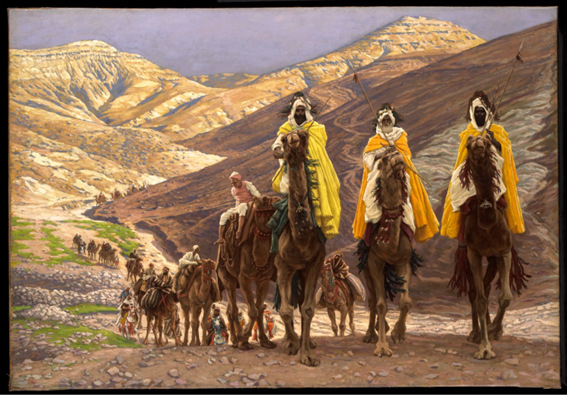
REBEKAH COCHELL | GUEST James Tissot, Journey of the Magi, 1894, Minneapolis Institute of Art. Public Domain.  There is a Christmas poem that has haunted me ever since I read it years ago: The Journey of the Magi by T. S. Eliot. It is not your typical cheerful Christmas poem; it has a somber tone, contrasting the Birth of Christ with death. Yet I keep revisiting it, finding truth and beauty—and, ironically, Christmas cheer. If you are unfamiliar with it, you can read it here. A Brief History  Between 1927 and 1931, the publisher Faber & Gwyer created Christmas pamphlets called the Ariel Poems. Each pamphlet was a collection of beautifully illustrated Christmas poems meant to be given as Christmas cards. They were collaborations between popular poets, artists, and typographers. Among them, Eliot’s Journey of the Magi (1927) stands out as a strange inclusion.  It begins:  ‘A cold coming we had of it,  Just the worst time of the year  For a journey, and such a long journey:  The ways deep and the weather sharp,  The very dead of winter.’... 
The Journey of the Magi: A Christmas Reflection 2025-11-28T15:31:14+00:00

The Art of Thankfulness

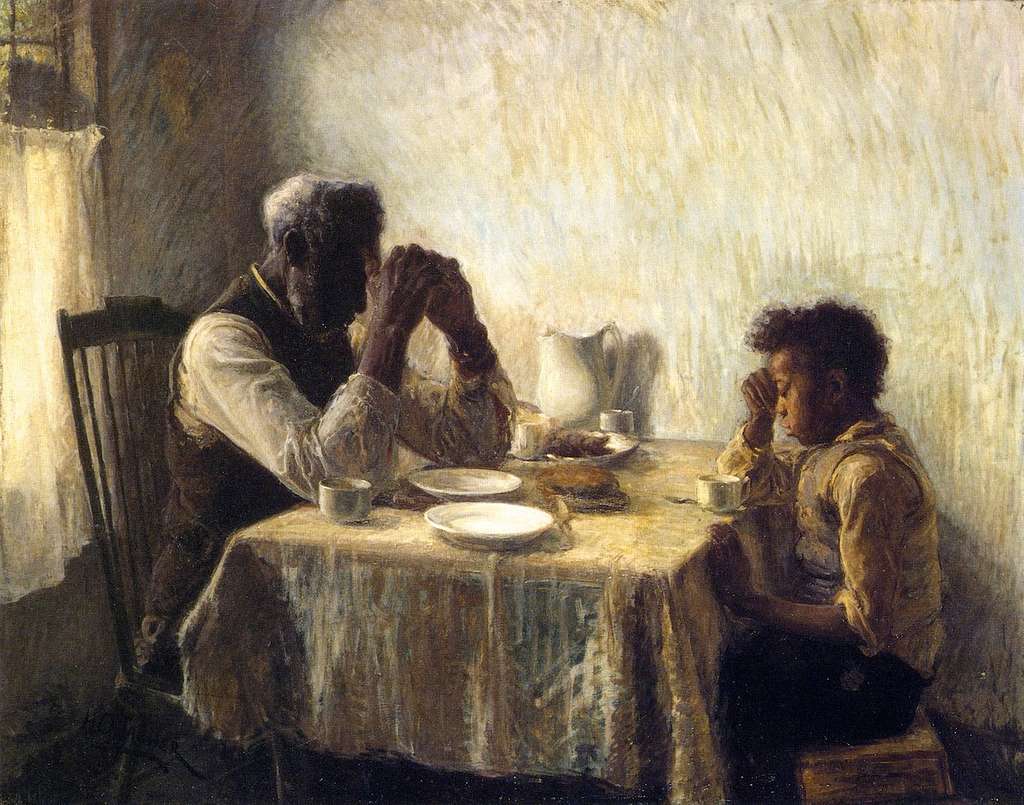
REBEKAH COCHELL | GUEST Henry Ossawa Tanner, The Thankful Poor,1894, Art Bridges Foundation currently exhibited at the Memphis Brooks Museum of Art. “Do not be anxious about anything, but in everything by prayer and supplication with thanksgiving let your requests be made known to God.  And the peace of God, which surpasses all understanding, will guard your hearts and your minds in Christ Jesus.” Philippians 4:6-7 Art can reveal truth, beauty, and goodness by depicting the spiritual transcendence of everyday life. “The Thankful Poor” by Henry Ossawa Tanner reveals a humbling lesson in thankfulness instead of merely offering us a depiction of the harsh realities of the late 1800s. Thanksgiving Reflected in Art Henry Ossawa Tanner was an artist born in Philadelphia in 1859. His experiences as a Black artist, during the Reconstruction and the Industrial Revolution in America, and in France shaped him as a Christian and an artist. He was a follower of Christ and painted many biblical narratives. He didn’t limit his Christian lens to just biblical paintings. His everyday “genre” scenes were imbued with deep emotional and spiritual depth, as well. As we look at this painting, we see an elderly man with graying hair and a young boy sitting at a table. The table is set simply, white dishes, cups, and pitcher with a modest meal, on top of a creamy yellow cloth tablecloth. The walls are bare and plain white. But the light from the window filtered through white curtains fills the room and all in it with an ethereal glow. The elderly man’s hands are clasped, eyes closed, and head bowed in a posture of reverent prayer. The young boy’s eyes are closed and head bowed, resting on one hand. His posture is a little less formal, as his left hand rests on the edge of the table. Their clothing, simple yet sophisticated, depicting care. The scene is reminiscent of a Vermeer; quiet, still, a moment in time that is transcendent. The window light illuminates the interior space. The simple white jug, an essential everyday item, represents life giving properties.  Like Vermeer, Tanner depicts those who labor, rather than those in positions of power. He is telling a story. But the story is not defined; we don’t know who the man and boy are other than what we can observe in the image and know from history. The title of the painting lets us know they are poor. The room, the table, and the meal confirm this. We know from history that the Reconstruction and the following Gilded Age, when this was painted, did not result in wealth for the Black community. It did not end racial discrimination. Tanner himself, though extremely talented, faced discrimination. His paintings would be shown in “separate” exhibits since he was not White. He left America to pursue his art career in Paris, where he was recognized and his talent celebrated.   While we can and should lament the past, Tanner rose above it, and above those who mistreated him. He did not wallow in the injustice but used it to paint truth as in this painting where he depicts the dignity and worth of the old man and young boy, created in the Imago Dei...

The Art of Thankfulness2025-11-05T19:36:31+00:00

What Would Paul Say About the Olympic Opening Ceremony?

REBEKAH COCHELL | GUEST Last week, my husband and I met a man in Istanbul. He mentioned the Paris Olympics Opening Ceremony and shook his head. He said, “They don’t understand.  This “freedom” they want is just another type of bondage. Another type of control.” He went on to describe how society thrives on structure and boundaries, on the family unit being the foundation of society, and how religious beliefs and moral values enhance a culture.  The Olympic opening ceremony has caused quite a controversy. I took a particular interest in the banter. After all, it was “in my lane” as an art professor at a Christian university, currently teaching a course in “Art as Communication.” The performance that has caused so much controversy was a “tableau vivant,” a live re-enactment of a painting, and depicted a group of people, mostly drag queens and LGBTQ+ supporters behind a table. It included an immense plate filled with flowers and fruit and a man painted in blue with a flower wreath.  Immediately following the performance, there was an outcry from religious and conservative leaders throughout the world claiming this was a blasphemous parody of Leonardo DaVinci’s Last Supper fresco. Almost as immediate were the social media posts in response which claimed that Christians were not “cultured” or informed about art history since the performance was meant to re-enact another painting, The Feast of the Gods by Jan Hermanzs van Biljert...

What Would Paul Say About the Olympic Opening Ceremony?2024-08-14T13:43:12+00:00

On Joy and Glimpses of Heaven

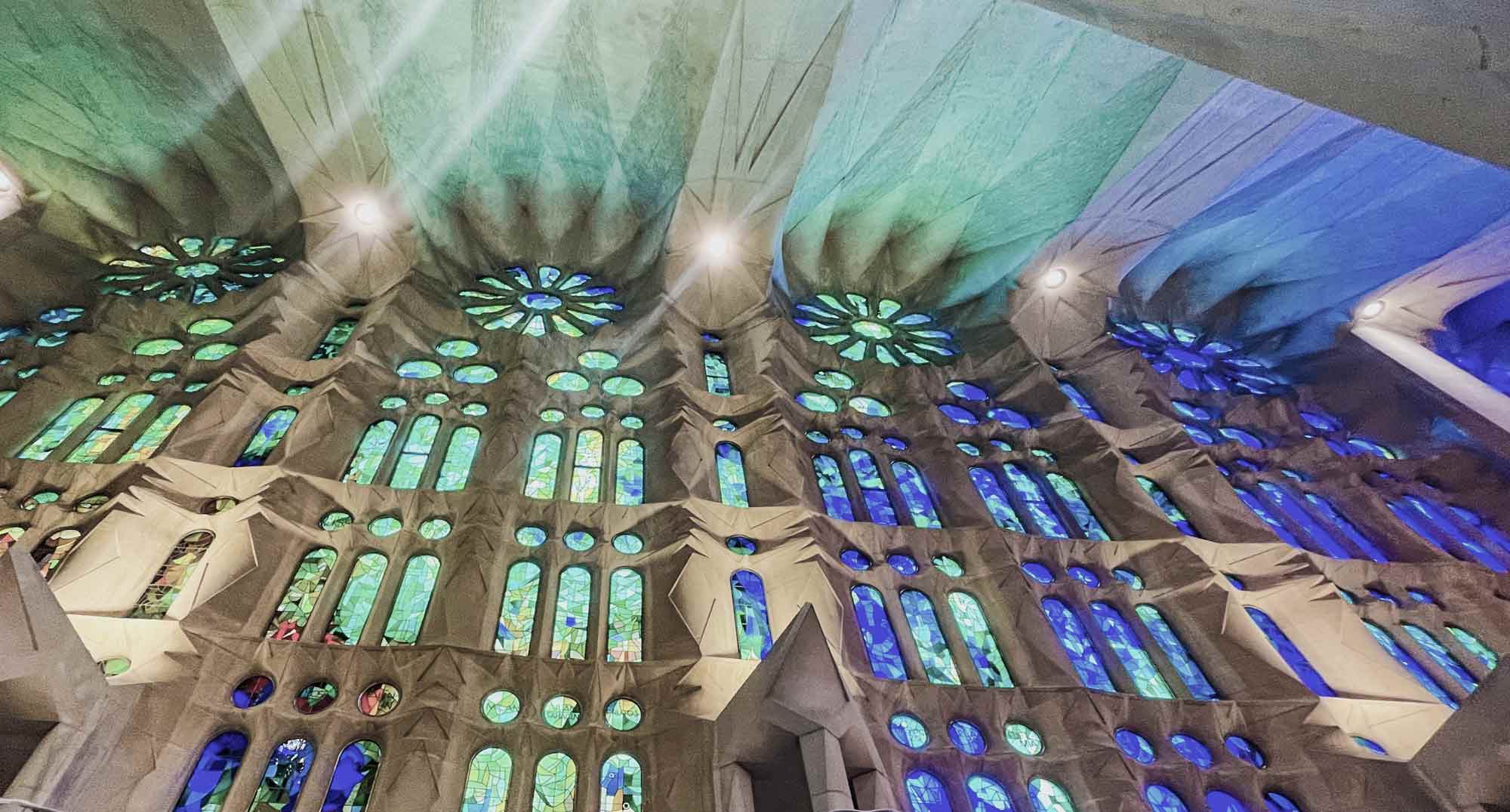
REBEKAH COCHELL|GUEST Architecture communicates through its structure. A government building with Greek columns speaks of democracy, justice, and order. The type of house we choose to live in can communicate our values and personalities. A church’s structure can tell us about the theology of the community that worships there. Typically, I prefer ancient Gothic cathedrals to any “newer” church buildings. Within an hour from my German home are at least three such churches that date back to the 1100s. Gothic cathedrals are symbolic “books.” They visually preach the gospel through the exterior of the structure’s flying buttresses and jambs (sculptures) and inside through stained glass windows, paintings, and more sculptures. Every aspect of a Gothic cathedral is symbolic, pointing to a reality greater than this present world. For a medieval worshipper, entering a cathedral was a symbolic entrance into heaven. An aspect of medieval semiotics (the study of signs and symbols) that is often overlooked is that symbols were more “real” than the present world to medieval worshippers. Since the reality of God and heaven was eternal and earthly existence was fleeting, symbols of the greater reality were more meaningful than the actual reality of Earth. Recently, my husband and I took a trip to Barcelona, Spain where there is a cathedral which has become the second most visited tourist site in the world. The Sagrada Familia looks unlike any other building on Earth, with its myriad of neo-gothic spires that could easily have been created for a science fiction or fantasy film set. Sagrada Familia broke ground in the late 1800s and is still not finished due to a myriad of political and financial reasons. I desired to see it but had no expectation that it could compare to a church built 800 years ago. I thought it would be gaudy based on some of the photos I saw. I was mistaken...

On Joy and Glimpses of Heaven2023-11-15T21:59:29+00:00

When Art Reminds Us of Eternal Truth

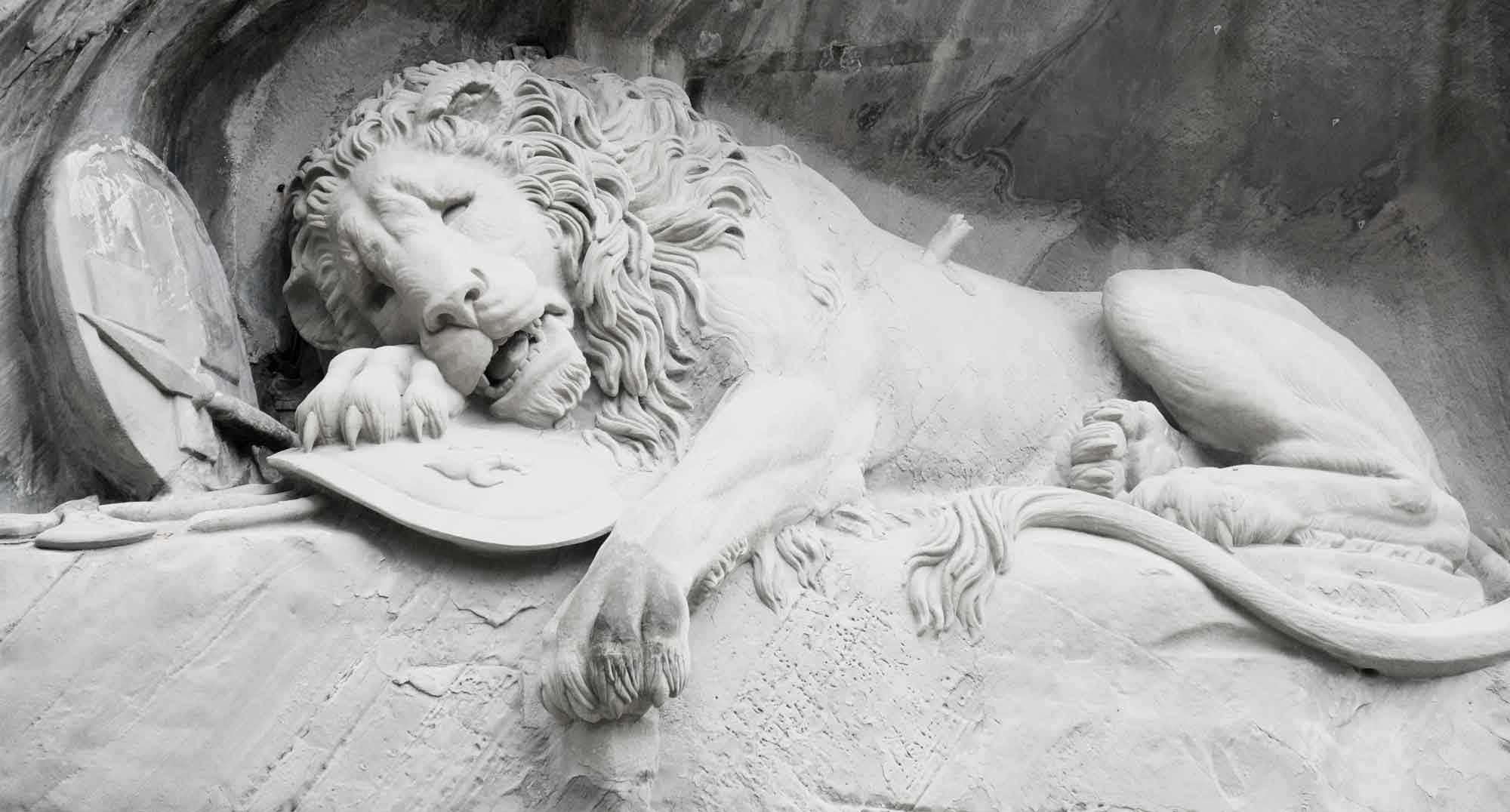
REBEKAH COCHELL|GUEST “...the Lion of Lucerne is the most mournful and moving piece of stone in the world.” —Mark Twain Art has a transcendent quality. It can cause us to contemplate the struggles and joys of human experience. Sometimes it overwhelms us with the beauty of the mundane or the eternal. I believe that the search for truth, beauty, and goodness is inherent to the artistic process and is so embedded in the human heart that even if artists do not acknowledge the Creator in their hearts, their art often communicates some truth of the Divine.   Since moving to Europe, I have encountered powerful aesthetic responses to beauty three times, bringing me close to tears, and taking my breath away. One of these times was when I visited the Lion of Lucerne in Switzerland...

When Art Reminds Us of Eternal Truth2023-03-24T17:47:29+00:00

Understanding Wisdom: An Artist’s Reflection

LISA TARPLEE|GUEST In the creative arts, the artist often uses a primer as the first step of her work. Before any color or lines are added, she covers the surface to prepare it to better receive mediums such as paint, pastel, charcoal. Priming readies the substrate to better display the artist’s vision as it allows the colors to shine pure and vivid in color and contrast. Rather than store-bought primer, I often prefer to prime my artwork with pages of prayers, Scripture, hymns, and books. The words feed my spirit as I compose them carefully on the substrate. Most of them end up covered upon completion of the piece, but I find that this beginning step slows me down and primes my soul to know God through the work and commune with Him as I create. I also sense that laying truth, prayers, praises, and laments, primes the artwork to shine His glory to those that view it...

Understanding Wisdom: An Artist’s Reflection2023-03-24T17:50:54+00:00

He is Your Shepherd, Dear Lamb

Who is your shepherd? Who are you seeking to follow? A couple months ago, I spoke to a group of college women and was asked to discuss what my faith was like in college. I expressed that, as a Christian, I struggled to understand what it means to be God’s child. I failed to grasp that I was precious to God. I grew up in a home that was chaotic. It was questionable about who was in charge and I often felt like I had to be in charge, though I didn’t want to be. I wasn’t able to even be a child most of the time. This earthly experience rubbed off, and sometimes still does, on my faith. I didn’t feel invited to be a child of God—even though God’s word assured me that I was through faith (Galatians 3:26). As I talked about that struggle in the college ministry meeting and noticed where I am today many years out of college, I saw a beautiful picture of God’s faithfulness. Over all these years, God has done what He promises. He continually pursued me and loved me (Psalm 139:7-8). While there is still a lot of transformation and growth to take place in life, God has sought me and kept me in His flock. He has shepherded me and reminded me,  I am His little lamb.

He is Your Shepherd, Dear Lamb2022-05-07T23:38:37+00:00

Created to Create

The other day I spent a few hours painting. If I had said that years ago you could be sure I was referring to something productive like painting a room in the house. I would have been redoing ill-conceived decorating choices or cleaning up scuff marks from our family of small children. It would have been purposeful. Needed. Practical. There is simply no way I would have been able to sit, surrounded by craft-store acrylics and a mason jar of brushes, to simply to create something. Not when there were so many other, more important things that needed my attention. But that is exactly what I did, and I loved every moment. Made to Create Spending any appreciable amount of time just creating says a lot about how I’ve changed over the years, to be sure, but it says more about how my theology has changed. You see for a long time, I’ve viewed the Christian life as a sort of to-do list. A relationship with the Lord, absolutely, but defined by acts. I viewed my status as a Christian woman, a wife, a mom, a sister, a friend, all as being determined by what I did and by what I brought to the table. There is an aspect of obedience to the Christian life, what we do does matter, but for a long time that was all there was for me. Do more. Try harder. Hope it’s enough and probably do a little more just to be sure. It took me years to finally understand that we were created for more than just doing—we were created to create.

Created to Create2022-05-08T00:00:44+00:00
Go to Top