What I Got Wrong about Gethsemane

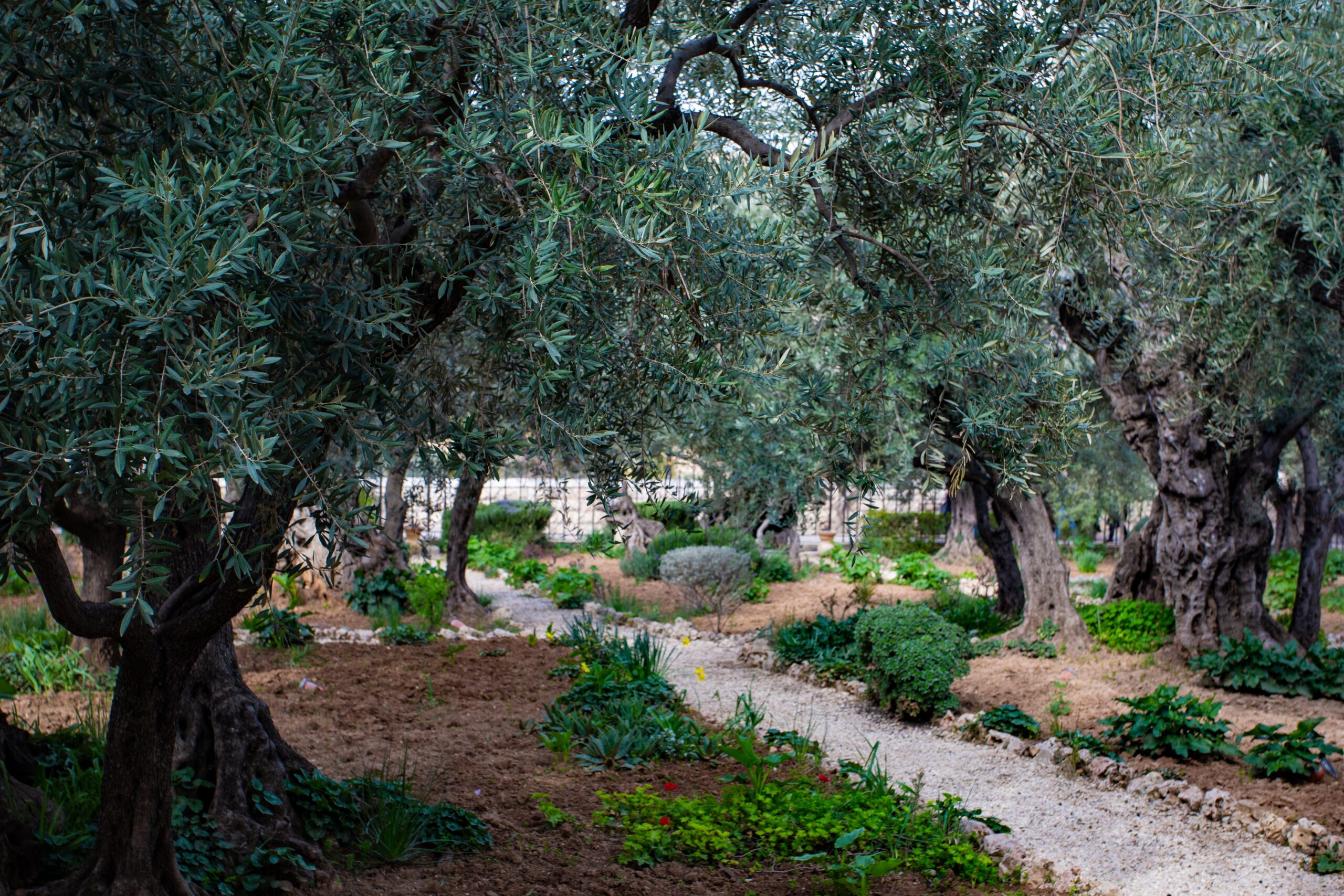
LEAH FARISH|GUEST I grew up looking at a lugubrious, Victorian-era painting of Jesus in the Garden of Gethsemane. I knew that as He prayed there the night before His crucifixion, He sweated blood and asked that God “let this cup pass.” But somehow I was left with the idea that He was solely focused on His own upcoming suffering, perhaps doubting and fearing as He anticipated humiliation and torture. Lately, though, I have sensed that His anguish was for us, not so much for Himself. His humanity surely dreaded torture and death. Sweating blood, He showed us the horror He felt as He contemplated His sacrifice. This makes His resolve that much more poignant. Isaiah 50:6-7 prophesied it: “I gave my back to those who strike,   and my cheeks to those who pull out the beard; I hid not my face   from disgrace and spitting.  But the Lord God helps me;   therefore I have not been disgraced; therefore I have set my face like a flint,   and I know that I shall not be put to shame. Perfect love casts out fear; in His perfect love for us, fear did not deter Him. He was Truth; He wasn’t doubting. He must have acutely dreaded the next hours, but He wasn’t shrinking back; “for the joy that was set before Him He endured the cross, despising the shame” (Heb. 12:2). He knew He would be raised from the dead and vindicated (Isaiah 50:8, Psalm 22:29-31, Mark 8:31-2). But the church was just embarking on its path through a dark world, and that night in the garden He must have seen its weakness and vulnerability with heartbreaking clarity. He saw that the church would be on earth for centuries, in our puny flesh and faith “filling up what is lacking in Christ’s afflictions.” His followers had proved themselves utterly unready to unite in witness, despite His warnings and exhortations....


What I Got Wrong about Gethsemane2026-03-18T15:02:21+00:00

For the Glory of God

KC JONES | GUEST Some of us are old enough to remember Michael W. Smith’s popular song, “Above All.” Smith’s soft, mellifluous tones, coupled with his worship of God made for easy listening on the ears and edified believers far and wide. While this is still true of many and has even moved into the realms of warm and fuzzy nostalgia, it wasn’t until hearing the song again recently that I stumbled across a core memory of mine; a simple conversation of a theological nature between my father and me regarding the song and the nature of our worship. It pertains to the refrain of the song,  Crucified, laid behind a stone You lived to die, rejected and alone Like a rose, trampled on the ground You took the fall and thought of me Above all As I considered Jesus' posture during His incarnation and even more specifically before and during His crucifixion, it was impressed upon me that Jesus' chief consideration; His highest priority, as it were, was not of us, in fact, but of the Father Himself... 

For the Glory of God2026-03-18T15:00:23+00:00

Easter: An Eternal Plan

SHARON ROCKWELL | CONTRIBUTOR A nearby freeway has a new billboard that simply says “God is One. Not three-in-one.” Our first-grade granddaughter was able to read the short message and exclaimed to her mother “That’s not right! God is three in one—Father, Son, and Holy Ghost. And Jesus is the Son. He died on the cross but now He is alive!” What joyful words to hear from a child whose parents and Sunday School teachers have poured into her biblical truths in ways she can understand and even differentiate false doctrine when she sees it! All for His Glory That anti-Trinity billboard is sponsored by a group focused on correcting what they see as biblical errors. But their beliefs contradict doctrinal truths and distort the gospel. The truth of the gospel should be clear and close to us all “in our mouths and in our hearts” (Rom. 10:8). This is especially relevant in the Easter season. This is a time to strengthen our understanding about God’s plan for our salvation. God created this world for His glory. This is a remarkable precept to remember: everything exists for the glory of God. This one truth will dictate how we think and behave. “Whether you eat or drink, or whatever you do, do all to the glory of God” (1 Cor. 10:31)...

Easter: An Eternal Plan2026-03-18T14:55:47+00:00

The Lamb of God

SHARON ROCKWELL | CONTRIBUTOR Every year for Easter dessert my mother would use a special mold to create a cake shaped like a lamb lying down. The cake would be frosted with white icing and covered in coconut to resemble the lamb’s soft wool. This cake was eagerly anticipated by all of us kids, especially with hopes that one of us would get the head – it had the most frosting! The tradition that came from my father’s family was that the youngest child would be asked why we had a lamb cake for Easter dessert. One by one, each of us learned the proper answer, because “Jesus is the Lamb of God who takes away the sin of the world.” I admit that early on, I did not make the connection between the lamb cake and Jesus. I knew the story from Exodus. God orchestrated the Jews’ escape from the Egyptians by sending plagues to change Pharaoh’s heart. The last plague was the death of all of the Egyptians’, and only the Egyptians’, first-born. The Jews marked their door posts with lamb’s blood so that Death would “pass over” their homes. The plague convinced Pharoah to free the Israelites. Later I came to understand that God did not let the destroyer kill any of His people who believed (Ex 12:23), foreshadowing a time when Christ would protect His own who believed in Him. Much detail was provided to the Israelites regarding the preparation of the lamb to be sacrificed. Exodus 12:1-6 explains that families were to get a lamb on the tenth day of a certain month, examine it, and sacrifice it on the fourteenth. The lamb was to be without blemish. The Jewish families were to assure their lamb was perfect, a picture of what God demanded of their sacrifice in grateful thanksgiving for their deliverance from Egypt and a foretaste of the sacrifice of His sinless son for believer’s deliverance from sin and death...

The Lamb of God2025-04-03T15:54:01+00:00

Ordinary Women, Extravagant Gifts

JAMYE DOERFLER | CONTRIBUTOR A few days before his death, Jesus attended a dinner party with his disciples. A woman arrived with an alabaster jar of pure nard, an extremely expensive perfume, broke the jar and poured the oil on Jesus’ head. Most people in the room disapproved of the gift. Mark says the men were “indignant” and rebuked the woman harshly for not selling the nard and giving the money to the poor instead. Yet Jesus defended her: “Leave her alone,” said Jesus. “Why do you trouble her? She has done a beautiful thing to me. For you will always have the poor with you, and whenever you want, you can do good for them. But you will not always have me. She has done what she could; she has anointed my body beforehand for burial. And truly, I say to you, wherever the gospel is proclaimed in the whole world, what she has done will also be told in memory of her” (Mark 14:6-9). When the woman anointed Jesus with her precious oil, it showed that she understood that Jesus was worthy of such extravagance. Clearly, she grasped this better than even Jesus’ loyal disciples who condemned her gift. As James R. Edwards points out in his commentary on Mark, “The disciples’ condemnation of the gift demeans the woman and her gift, and also Jesus, whom they regard as unworthy of such extravagance.” The value of a gift Not everyone is able to give such an expensive gift, of course. A few chapters earlier, Jesus similarly commended another woman, even though her gift was of little monetary value: the widow who could only afford to put two copper coins into the temple treasury.   To his disciples, he said, “Truly, I say to you, this poor widow has put in more than all those who are contributing to the offering box. For they all contributed out of their abundance, but she out of her poverty has put in everything she had, all she had to live on” (Mark 12:43-44). Though the phrasing is different, Jesus recognizes both women for the same motivation: “she has done what she could” and “she has put in everything she had.” As Edwards writes, “For Jesus, the value of a gift is not the amount given, but the cost to the giver.”...

Ordinary Women, Extravagant Gifts2024-03-19T13:46:10+00:00

Your Will Be Done

BARBARANNE KELLY|CONTRIBUTOR “Our Father, who art in heaven, hallowed be thy name. Thy kingdom come, thy will be done, on earth as it is in heaven . . . “ We pray this every Sunday morning, standing among the assembled saints. Heads bowed, holding hands, we pray for the Lord’s will. Some may pray it by rote, invoking the Name and the petitions in the same manner as every week, mind wandering. There may be some for whom the words are new, and they follow along in the bulletin. For many, there may be something particular in mind as they plead for God’s holy will to be done in their lives, praying with urgency, heavy hearts, even fear. Have any saints prayed these words with the urgency felt by our Lord on the night before his crucifixion? “My Father, if it be possible, let this cup pass from me; nevertheless, not as I will, but as you will” (Matt. 26:39). Our Lord knew what was coming. He’d been born for this purpose: to save his people from their sins (Matt. 1:21). From the beginning of his ministry, he marched toward the cross with undaunted resolve. When Satan offered him all the kingdoms of the world without the cross, Jesus rebuked him in the strongest terms (Matt. 4:10). And when Peter tried to dissuade him from his mission, Jesus rounded on him with the same strong rebuke: “Get behind me, Satan! . . . you are not setting your mind on the things of God, but on the things of man” (Matt. 16:23)...

Your Will Be Done2023-08-15T13:39:27+00:00

Light Palms, Heavy Burden

AIMEE JOSEPH|GUEST Palm Sunday. The expectant people lined the streets, praising Jesus and quoting from Psalm 118 as he approached in peace. The people knew he was the Messiah, the Sent One, the One coming to save them. Thus, they shouted “Hosanna” which means “Save us, now!” (Matt. 21:6–11). They waved light palms as he approached history’s heaviest burden. Their praise presupposed that Jesus would establish God’s people in peace politically and do so immediately. They had visions of the once-flourishing reign of David. Their hopes soared with high expectations that Jesus would usher in a new golden era. However, within a week’s time, it would become clear to these same crowds that Jesus had plans to usher in a very different kingdom. As a result of these missed expectations, their praises faded quickly into shouts of “Crucify him!” in a matter of days. We are not unlike them; our praise quickly turns cold and bitter when our expectations are not met in our way and on our timetable. As we approach Holy Week, we are invited to search for the semblances of our own hearts in the fickle crowds. Jesus rode into Jerusalem through a tunnel of praises that came from the mouths of those who would soon chant “Barabbas!” (Matt. 27:15–23). They cheered his approach with a light and airy joy, but he alone knew he was marching on to his death. His patient restraint and resolve as he approached an unthinkable burden only further shows the purity of his goodness and love. His Burden A King approaching in peace, In humility He rode on, Onlookers cheering him, Expecting a new dawn. The Scriptures foretold it, Yet none of them could see, The dawn would begin with The God-Man hung on a tree. The Messiah was coming, To bring His kingdom to bear; But of the coronation of tears, None but Jesus was aware. “Hosanna! Save us!” they cried, As hopes and palms were raised. “Finally the kingdom’s come, May Jesus’ name be praised!” He heeded not their fanatical cries, For he well knew the heart of men, From “Crown Him” to “Crucify,” The voices would be raised again...

Light Palms, Heavy Burden2022-05-04T23:14:32+00:00

How the Resurrection Comforts us in Our Waiting

When I signed on to write this post, I had no idea the world would be in the midst of one of the hardest waits we’ve ever faced, the global pandemic of 2020. As I write, Americans are being urged to stay home from school, work, church, even from the doctor’s office. We stay home, and we wait. We wait to see if the curve will be flattened; we wait to see if the virus will strike us or our loved ones; we wait to see what will happen to the economy when it’s all over. It feels as if the whole world is trembling as it waits. And yet, even as we wait in this nerve-shattering season, because of the resurrection, we wait with hope. Unlike the first followers of Jesus on the day after his death, we know there is a better day coming. The First ‘Already/Not Yet’ Day You may have heard the phrase “the already and the not yet” in a sermon or read it in a book. The “already” refers to the fact that Jesus has “already” died for our sins and been raised to new life, that his followers have “already” known the cleansing of our sins and our adoption as God’s children. The “not yet” refers to the fact that Jesus has “not yet” returned to fully restore all of creation; indeed, we groan with all of creation for the redemption of all things (Romans 8:22-23). In this season of the “already/not yet,” we eagerly await the day when Jesus will return to fully and finally restore all broken things...

How the Resurrection Comforts us in Our Waiting2022-05-05T00:52:45+00:00
Go to Top