Awaiting the Light of the World

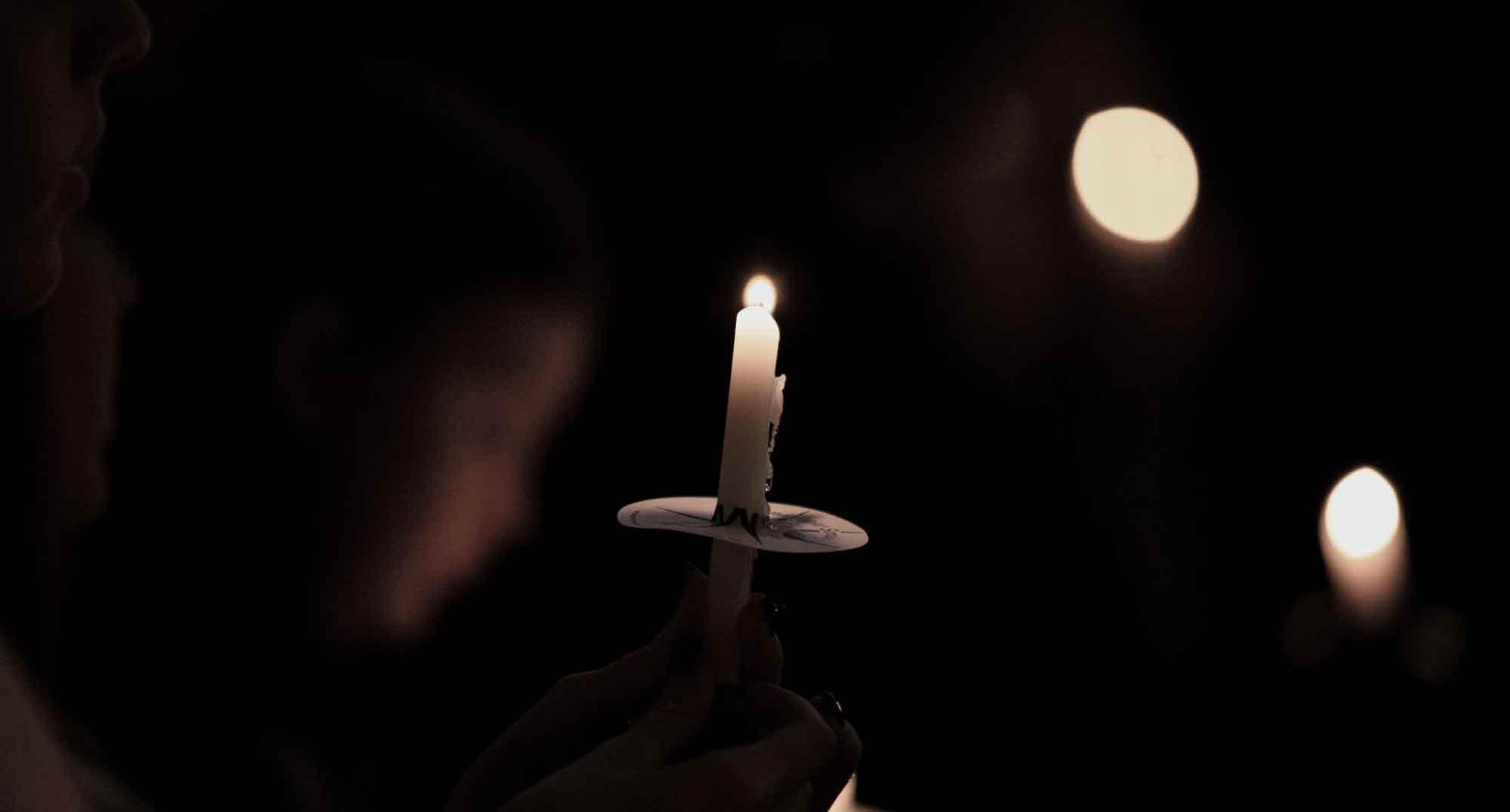
KERRY ANDERSON | GUEST I’ve always loved that we celebrate Christmas during the darkest week of the year (at least in the Northern Hemisphere). I love that Christmas lights start going up just as the days are the shortest. In the dark mornings, I love coming downstairs, not to a dark and lifeless kitchen but to the warm light of the Christmas tree that turns on before I wake up (thank you, light timers!). And I love that when we’re introduced to John, the forerunner to Jesus, in John 1, scripture tells us that John “came to bear witness about the light”…to tell us that “The true light, which gives light to everyone, was coming into the world” (John 1:6-8,9). There are so many descriptors and names for Jesus throughout the Bible, but in these verses, we’re told that what is coming is light, the true light. What we’re waiting on in this dark month is the Light of the World.  O Splendor of God’s glory bright, from light eternal bringing light, O Light of light, light’s living Spring, true Day, all days illumining...


Awaiting the Light of the World2025-12-06T17:51:18+00:00

Waiting in the Hope of Coming Redemption: Walking with Our Sister Anna

ELIZABETH TURNAGE | CONTRIBUTOR “Lead us this day, Lord Christ, that we might walk its paths in the light of the hope of our coming redemption. Amen.”[i] As we move through the season of Advent, which literally means “coming forward,” we remember that God’s chosen people once waited for our Redeemer to come and now await His final return. Advent is a season of waiting. What indeed does it look like to walk the paths of each day “in the light of the hope of our coming redemption”? Anna, the prophetess and widow of Luke 2:36-38, shows us the way. When we meet her in Luke 2, Anna is an older woman, either 84 or 104.[ii] Widowed as a young woman, probably around the age of 20, and apparently childless, Anna had no means to support herself. She likely became a recipient of Ancient Near Eastern welfare, moving near the temple, where she could access food and shelter. Despite her many losses, Anna avoided the secondary suffering that can add to affliction—she refused to indulge in self-pity. Instead, she devoted her life to waiting for redemption. Over time, she became known as a prophetess, someone who delivers messages from God. As we study how Anna spent her days, we discover a compelling portrait for walking each day in the hope of redemption. Anna shows us how to wait for our returning Redeemer who will one day come to restore all broken things...

Waiting in the Hope of Coming Redemption: Walking with Our Sister Anna2025-11-28T15:27:35+00:00

A Wonder-Filled Advent

MARIA CURREY | CONTRIBUTOR What sparks wonder in your mind and heart? Psalm 77:11-12 is our call to WONDER! “I will remember the deeds of the LORD; yes, I will remember Your wonders of old.” Oh, that this will be an Advent season of wonder for you! When you consider who God is and what He’s done for you, how do you behold Him in amazed wonder and awe? Childlike Wonder Children understand what WONDER means. They are filled with wonder over the smallest things: the feathers of a bird, the amazing, assorted animals at the zoo, the yummiest flavors, a creeping caterpillar. Meandering our way through the wonder of their favorite animals, my grandchildren enjoy many-striped zebras, long-necked willowy giraffes, floppy-eared, giant grey elephants, all created by our God of wonder. How about favorite childhood flavors? My mom is a 92-years-young woman of wonder; she was a foodie before they were named as such. She happily lavishes favorite flavors on her family, lovingly making rhubarb custard pie for my oldest brother, carrot pudding and vanilla sauce for the youngest, all thoughtful flavors of wonder. These lighter-level delights make me think that in a much grander and more WONDER-filled way, God loves us. He surrounds us with wonder in all of His Creation, lavishing us with tangible reminders of His wondrous love!...

A Wonder-Filled Advent2025-11-22T18:29:46+00:00

Advent Devotional: Isaiah 9:2

STEPHANIE FORMENTI | CONTRIBUTOR Christmas is a season of light. We have lights on our houses, lights wrapped around our trees, candles in our windows, and fires in the hearth. It makes sense when we consider how the days are short and the nights are long and cold during winter (at least in the Northern Hemisphere). Imagine Christmas without lights. It would be so dark and cold. This is especially true when darkness seems particularly overwhelming, deep, and oppressive. The beauty of light is most noticeable in years marked by significant loss or disappointment. The brightness of a flame is most poignant in moments of sadness, despair, hopelessness, and worry. Often, it is when we understand the oppression of darkness that we truly understand the power of light. This was true for the Old Testament people of God. In Isaiah 9:2 we read, “The people who walked in darkness     have seen a great light; those who dwelt in a land of deep darkness,     on them has light shone.” The prophet is referring to Israel’s history of exile and homelessness. Their own disobedience landed them in a place of oppression by their enemies, enshrouded in spiritual darkness. Notice the verbs: “walked” and “dwelt.” This was no passing darkness and no temporary shadow. They were existing in darkness. It was their home. But Isaiah’s prophecy is one of hope; they will not wander around in darkness forever. Rather, a great light will burst onto the scene and make the darkness flee. And this light will bring joy (Isaiah 9:3), peace (9:4), and righteousness (9:7)....

Advent Devotional: Isaiah 9:22023-12-04T14:30:28+00:00

Advent Devotional: Micah 5:2

BARBARANNE KELLY | CONTRIBUTOR But you, O Bethlehem Ephrathah,     who are too little to be among the clans of Judah, from you shall come forth for me     one who is to be ruler in Israel, whose coming forth is from of old,     from ancient days. — Micah 5:2 Do you ever get lost while traveling, and need to stop to ask for directions? It’s tempting to read the journey of the wise men in the Gospel of Matthew in terms of the logistics of pre-modern travel. The wise men’s astronomical GPS (the star) led them to the region of Judea, but to find their specific destination they needed to ask the local folks—road signs and maps to the birthplace of the Messiah not yet in existence. However, when Micah prophesied the birthplace of the Messiah centuries before the fact, the Lord was revealing far more than a location on a map for the sake of future travelers. Micah 5:2, speaks a word of hope to despairing people lost in their sins. This word of hope is a single signpost among many for lost and weary sinners, pointing the way to the birth of Christ. And the road to Bethlehem, joining other roads to become a highway of God’s covenant faithfulness, began in God’s covenant promise to David, a promise of peace and rest that would be achieved by the son of David whose kingdom would be established forever (2 Sam. 7:12–13). Though there were good kings among the sons of David, even the best of them were only fallen men. The few who were faithful could not undo the wickedness of those who had been unfaithful. Of all the kings of Judah, not one lived up to the promise of David’s greater son (1 Chron. 17:1–14). By Micah’s day, the judgment of the Lord was poised to strike because of the faithlessness of God’s people; they would soon be overcome by their enemies and hauled off to exile in a foreign country. And yet, even as prophecies of fearsome destruction flow from his lips, Micah breaks to speak of one who will be born in Bethlehem “who is to be ruler in Israel.” Who could this be but the promised son of David? When he says this ruler’s “coming forth is from of old, from ancient days,” he is certainly recalling the multitude of prophecies already made concerning David’s greater son, for this ruler “shall stand and shepherd his flock in the strength of the Lord,” (4; cf. 2 Sam. 5:2)...

Advent Devotional: Micah 5:22023-12-01T14:34:57+00:00

Advent Devotional: Isaiah 7:14

SARAH IVILL | CONTRIBUTOR With all the bells and bows, presents and programs, musicals and melodies of the Christmas season, there is no truth more comforting than the promise that God is with us. For many of us, the season can spark sorrow that seems to threaten our joy. How wonderful, then, that we can focus on the truth of God’s presence. One of the many passages of Scripture in which this truth is revealed is Isaiah 7:14, “Behold, the virgin shall conceive and bear a son, and shall call his name Immanuel [God is with us].” In the broader context of this verse (Isa. 6:1-7:17) we learn several important truths about the God we celebrate during Advent. First, He is great, glorious, and holy. Second, as the holy God, He is completely different than anyone or anything else. Third, He reigns over the entire world. There is no king like Him in all the earth. Fourth, no one can stand before Him apart from His Son, Jesus Christ. Finally, God’s Son will atone for the sins of God’s people. In the more immediate context of Isaiah 7:14, the Lord sent the prophet Isaiah to King Ahaz, who reigned over Judah at the time, with a difficult message: Israel and Syria would be destroyed. However, the Lord would preserve a remnant of true worshipers. Furthermore, the Lord gave Ahaz a sign. A virgin would conceive and bear a son who would be named “Immanuel [God is with us]” (Isa. 7:14). He would refuse to do evil and only choose to do good. This sign served as a guarantee that the king of Assyria would shatter both Israel and Syria, but in the midst of the darkness, God’s presence and God’s people would prevail...

Advent Devotional: Isaiah 7:142023-11-25T16:29:58+00:00

Advent Devotional: Jeremiah 23:1-6

CHRISTINE GORDON|GUEST 1“Woe to the shepherds who destroy and scatter the sheep of my pasture!” declares the LORD. 2 Therefore thus says the LORD, the God of Israel, concerning the shepherds who care for my people: “You have scattered my flock and have driven them away, and you have not attended to them. Behold, I will attend to you for your evil deeds, declares the LORD. 3 Then I will gather the remnant of my flock out of all the countries where I have driven them, and I will bring them back to their fold, and they shall be fruitful and multiply. 4I will set shepherds over them who will care for them, and they shall fear no more, nor be dismayed, neither shall any be missing, declares the LORD. 5 “Behold, the days are coming, declares the LORD, when I will raise up for David a righteous Branch, and he shall reign as king and deal wisely, and shall execute justice and righteousness in the land. 6In his days Judah will be saved, and Israel will dwell securely. And this is the name by which he will be called: ‘The LORD is our righteousness.’ (Jeremiah 23:1-6) Consider this scenario: you hire a babysitter to care for your young children for a few days. When you check in on them, you realize that instead of feeding them, the sitter has neglected them. Instead of keeping them safe in your house and yard, enforcing rules for their safety, the sitter has been so brutal that the children have run from the house, out into the neighborhood and streets. They are now hungry, unprotected, and flirting with danger. What might your heart for your children and your response to the sitter be? Any parent would feel protective love for the children and outrage mixed with enormous anger at the sitter.  Shepherds Failed God’s People This is the situation God is addressing in Jeremiah 23. God called Jeremiah around 626BC to prophesy to the southern kingdom of Israel. God’s words to these people included his anger with them for their idolatry, and warnings of a force coming from the north that would punish them if they didn’t change their ways. God spoke in particular about the failure of Israel’s leaders to care for his people. These leaders failed the people fantastically, leaving them ignorant and drifting into idolatry. In his protective love for his people, he provided priests, prophets, and kings to guide, protect, and uphold justice. In Jeremiah’s time, leaders were often referred to as shepherds. God intended for them to shepherd his people with tender care, as a shepherd protects his sheep. But far from that attentive watchfulness, these shepherds had abused their positions of power, and actually scattered the flock they were to preserve. In these words of chapter 23 we feel the anger of God and his heart for his wandering people who have not been pastored well. At this point in the book of Jeremiah, the first wave of exiles had probably already been taken out of the city of Jerusalem and transported to Babylon as prisoners. In verse two, God says through Jeremiah that because these shepherds had failed to attend his people with their love and care, he would attend the shepherds with his punishment...

Advent Devotional: Jeremiah 23:1-62023-11-15T21:56:42+00:00

When Hope is Deferred

JAMYE DOERFLER | CONTRIBUTOR Behind every book, there’s a story. When I tell the short version of the story behind my book The Advent Investigator, it goes like this: no one else had written an advent devotional geared toward middle and high schoolers, so I did. That sounds nice and tidy, but it’s not even close to the full story.  Before this book, there were others. Those books were pretty far removed from an advent devotional for teens. Before this book, there were literary novels. One, I wrote when my three boys were young, waking up every morning before they did to work. For six years, I wrote and revised based on feedback from friends and professionals. I submitted to literary agents and had close calls but no offers of representation. I filed away the “I think you’re a wonderful writer but…” emails. I took the “almost” phone call with an agent and put my head back down and continued working and submitting. I am nothing if not persistent. Then, one day, it broke me. I woke to another rejection in my inbox. This was nothing new, but for some reason, it was the one that crushed me. I sat in the rocking chair and wept with my husband. “I don’t know why I keep doing this to myself.”  I had to stop. Except that I couldn’t stop.  I’d been writing more or less daily since high school. I’d always had a sense that writing was a gift God created me with, that it was a key part of my identity and purpose on earth. How could I give up on that? With my children now in school, I wrote another novel and submitted it to literary agents again. Requests for the manuscript poured in. Later, so did the rejections. “As with your first novel, there’s much to be admired in your writing, but…”  I swallowed those bitter little pills like they were nothing; everyone knows rejection is inherent in art. A couple dozen went down easily. Then, like before, one of them made me choke.  I pulled on my sneakers and went for a run. Tears streamed down my face as I pushed my body until I could barely breathe, attempting to eclipse the emotional pain with bodily pain. I pleaded with God as I ran. Why did you give me a desire only to thwart it? Why did you make me like this?  By this point, I had put over ten years and thousands of hours into my novels. I’d eschewed other career paths and had pinned my hopes on this single outcome. I’m not being melodramatic when I say that this failure is the greatest disappointment in my life. “Hope deferred makes the heart sick, but a desire fulfilled is a tree of life” (Prov. 13:12)...

When Hope is Deferred2023-11-14T21:57:26+00:00

The Advent Wreath: Finding Comfort in the Light of Jesus

OCIEANNA FLEISS|GUEST Christmas music played softly as I leaned on the counter at the Christian bookstore where I worked alongside my new husband. “Advent?” I said. “Isn’t that when churches light candles around Christmas time?” We were in our twenties, still establishing our own family culture, and had been dabbling in some of the Christian traditions we hadn’t explored before. “Yeah, but I heard you can also celebrate it at home,” he answered. “How?” “I’m not sure, but I think we should start with an Advent wreath.” I agreed, and after some shopping, we settled on a gorgeous wooden wreath decorated with a Celtic knot that would sit nicely on our coffee table. It had four candles—three purple and one pink—to represent the four weeks of the Advent season. Later we added a white one, the Christ candle, to light on Christmas Eve. With joy I set it up in our California apartment, and each Sunday in December, as the sunshine filtered through our windows, we lit the candles and read the accompanying Scriptures for each week. The weekly Advent themes of hope, preparation, joy, and love nurtured a rhythm of worship our hearts needed—and have continued to need. We didn’t know then how, over the years, these themes would play out in our lives...

The Advent Wreath: Finding Comfort in the Light of Jesus2023-11-15T21:57:49+00:00

On a Silent Night

KATHY CHAPELL|GUEST Silent Night is my very favorite Christmas hymn. It speaks to believers AND non-believers around the world.  Those who know just who that infant in the manger was hear in this simple song the provision of a Redeemer by a loving Father.  And those who don’t know Him as Savior still love this tender song that is steeped in tradition and sentiment.  On Radiant Beams  Growing up in a tiny church in southern Illinois, I had two different impressions of the carol.  The first, I must admit, was based purely on the sentiment and sweetness of watching the adults in that church sing it. The church was founded in 1881 by German immigrants, and when I was young, most of the 25 members of Woodburn Presbyterian Church were either first-or second-generation German Americans.  So, when we sang this song, there were many who sang it in their heart language: “Stille Nacht, heilige Nacht, Alles schlaft; einsam wacht….” As they sang, with all the memories of family and heritage, these dear saints would sometimes close their eyes and weep as they sang.  Even as a little child, I knew that this song meant something important to them—and therefore to me...

On a Silent Night2023-03-24T17:45:35+00:00
Go to Top